
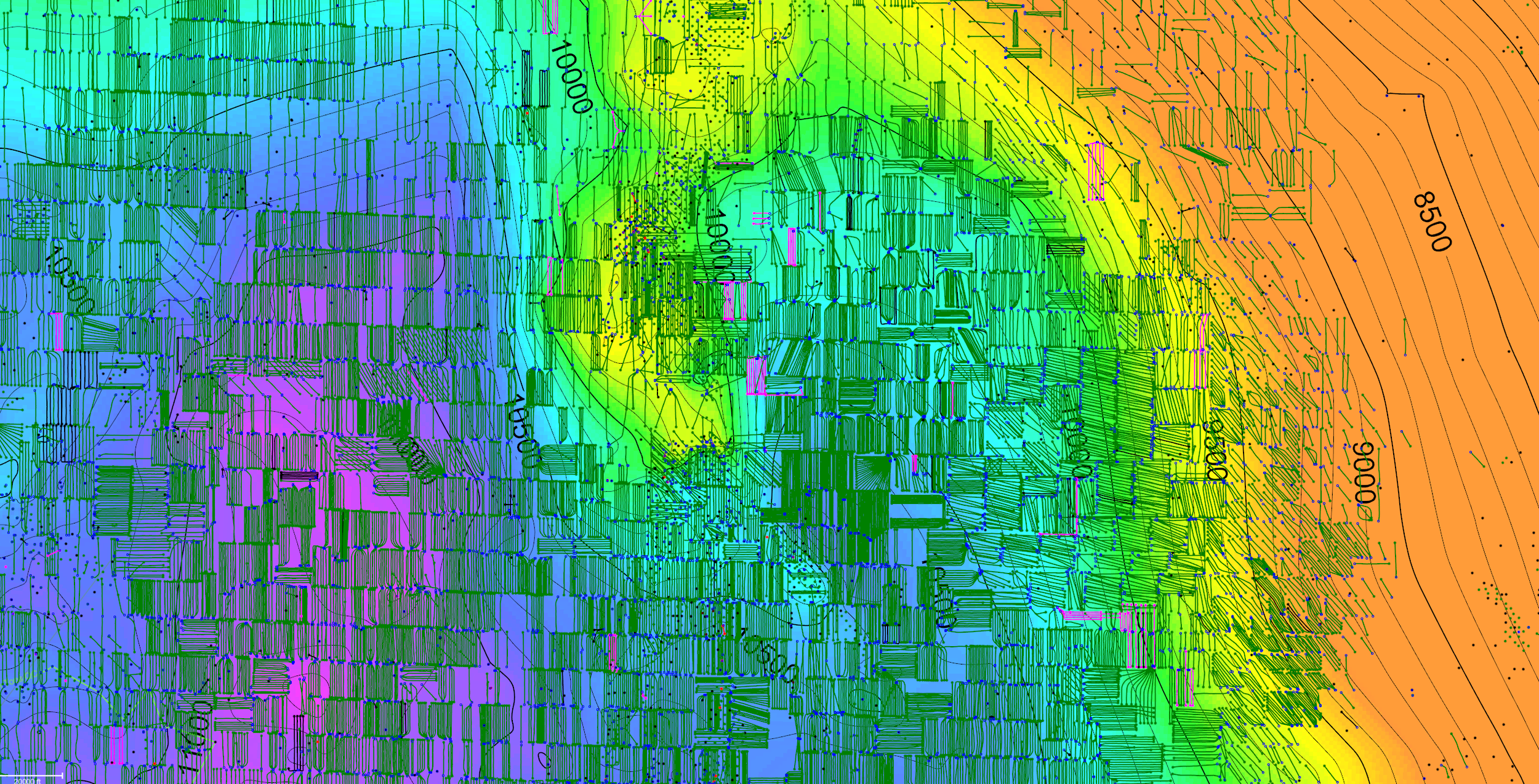
Independent pressure match and design fracture composite modeling study evaluating Hallux Mannanase HT enzyme breaker against conventional oxidizer breakers. A calibrated fracture model was developed from actual production data on an existing Bakken well, then used to forecast performance across four completion designs — incorporating independent regained proppant pack permeability testing and rheology properties into all modeling.
The Bakken analog well was completed using conventional slickwater with high-viscosity friction reducer (SW HVFR). Post-job production history match (PHM), forecasting, and discrete fracture network (DFN) pressure match modeling was conducted to calibrate a fracture model from the well's actual production data.
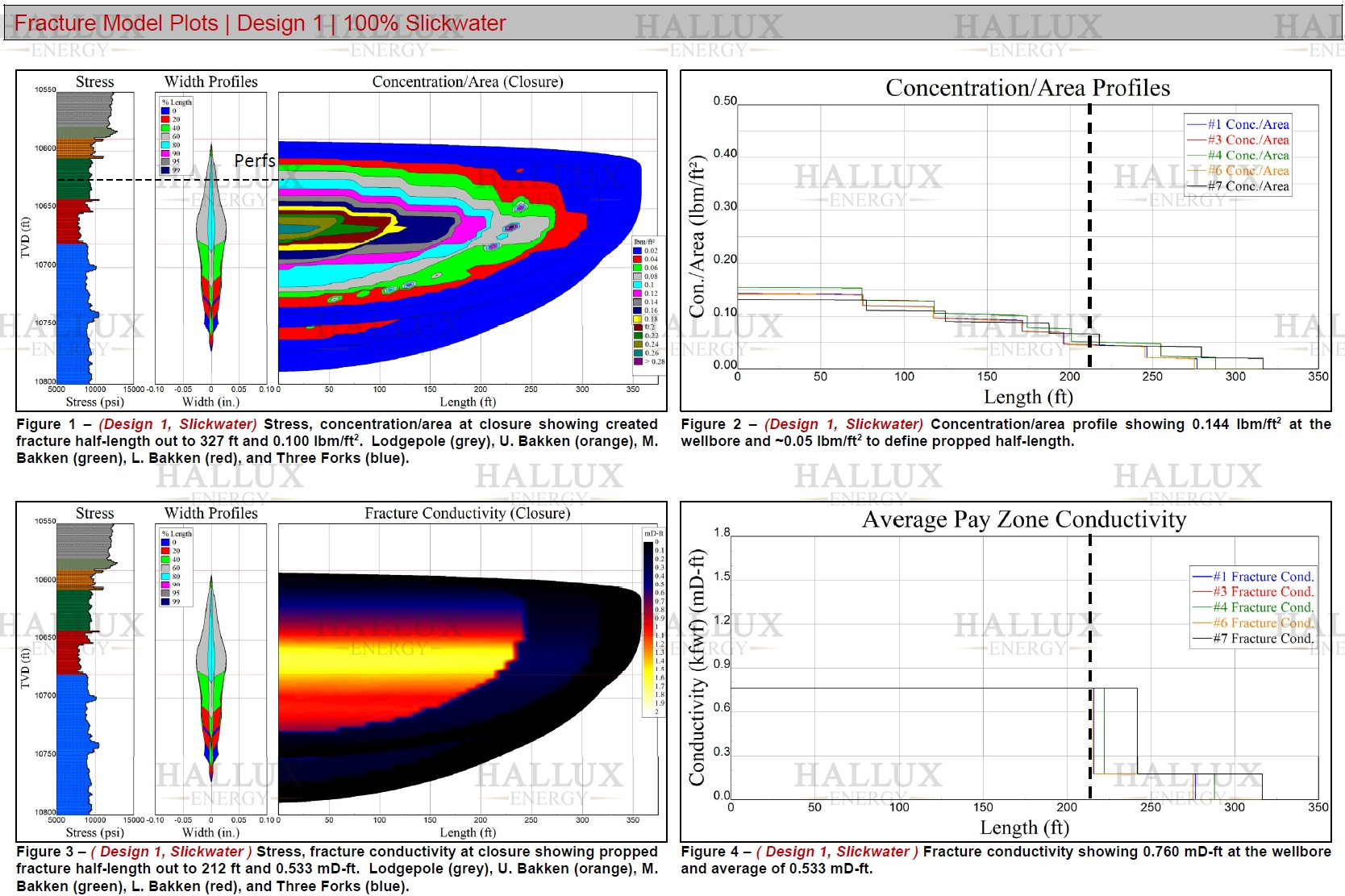
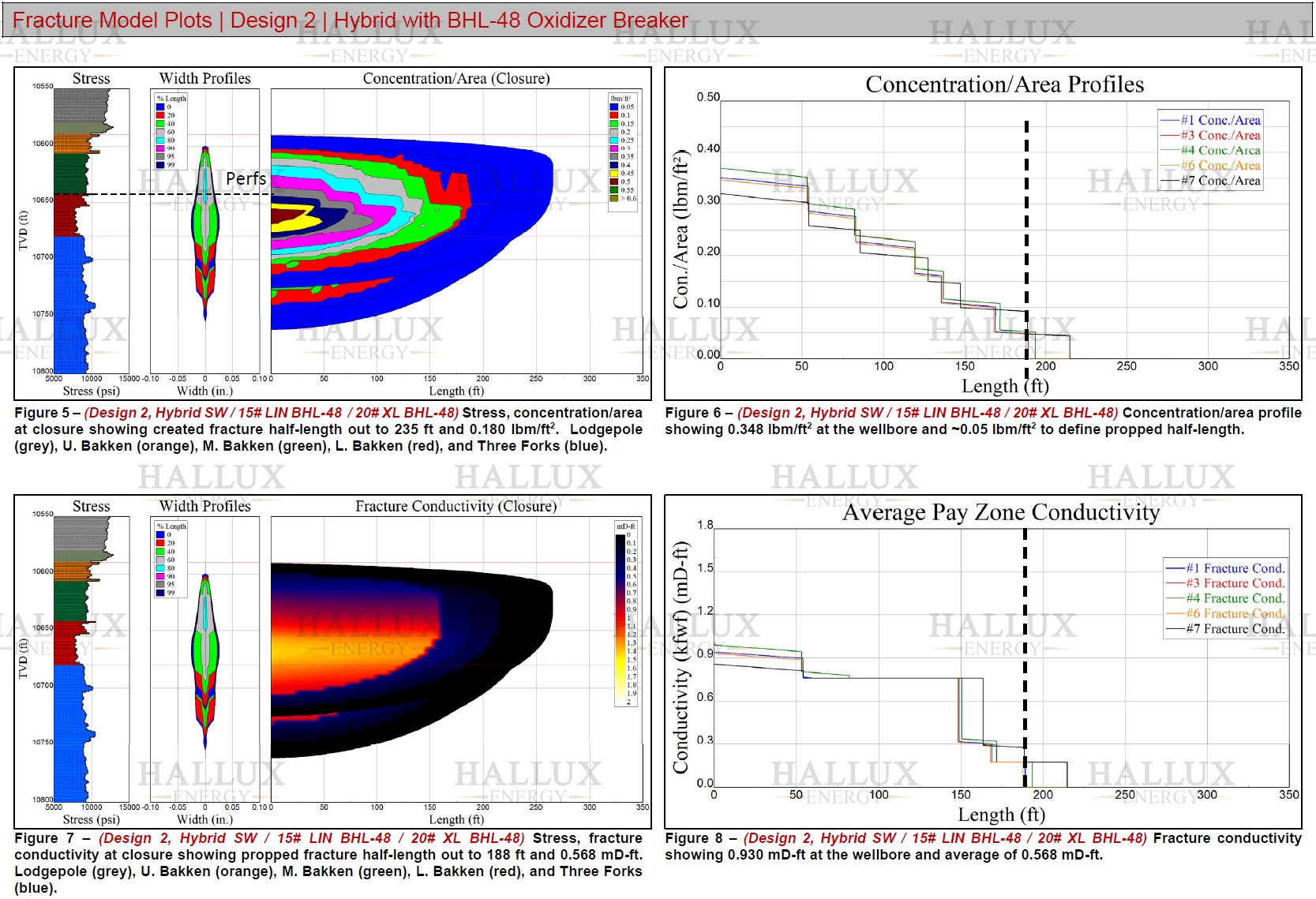
Using that calibrated model, four completion designs were developed comparing slickwater, hybrid, and full crosslinked gel fluid systems with either oxidizer or Hallux Mannanase HT enzyme breaker. Designs also evaluated potential 23–46% reduction in clean water volume when adjusting pump schedules.
Independent Regained Conductivity Testing:
Oxidative Breaker (commodity chemical): 30–40% Proppant Pack Clean-Up
Hallux Mannanase HT (Patented): 90–100% Proppant Pack Clean-Up
Regained proppant pack permeability testing results and rheology properties of the Mannanase HT enzyme breakers were incorporated into all the modeling.
Not all enzymes are created equally. Designs utilizing Hallux Mannanase HT enzyme breaker delivered 27–29% more production at 1 year (58–62 Mbbl additional) compared to the baseline well — with regained fracture conductivities of 1.23–1.44 mD-ft versus 0.47–0.57 mD-ft for oxidizer/slickwater designs, while simultaneously enabling 23–46% reduction in clean water volume. At current oil prices, this translates to $4–5+ million per year in additional revenue per well.
Production forecasts show 27–29% production uplifts at 1 year when using Hallux Mannanase HT enzyme breaker compared to the baseline completion.
Clean water volume reduction range of 23–46% when adjusting pump schedules and frac designs as suggested.
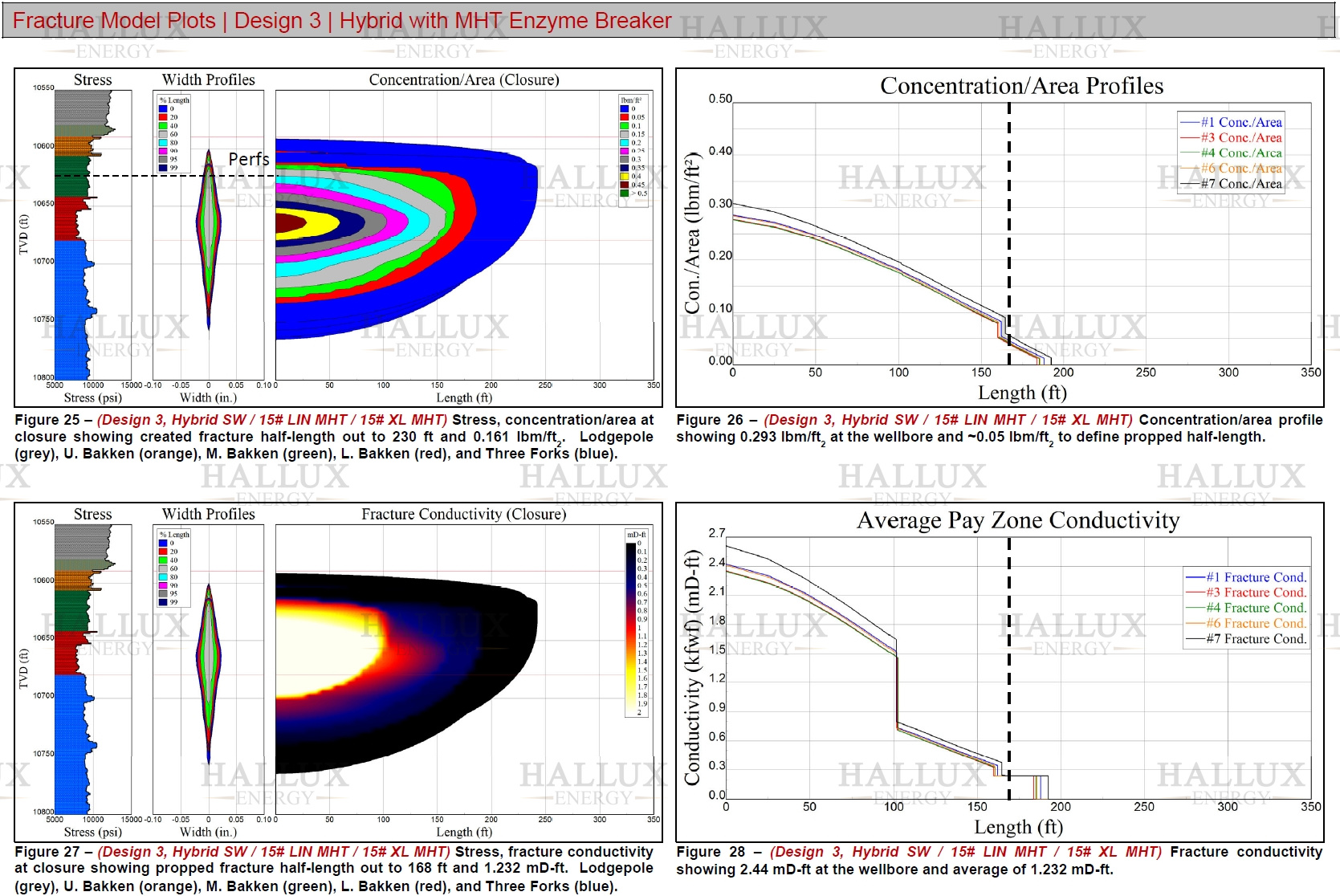
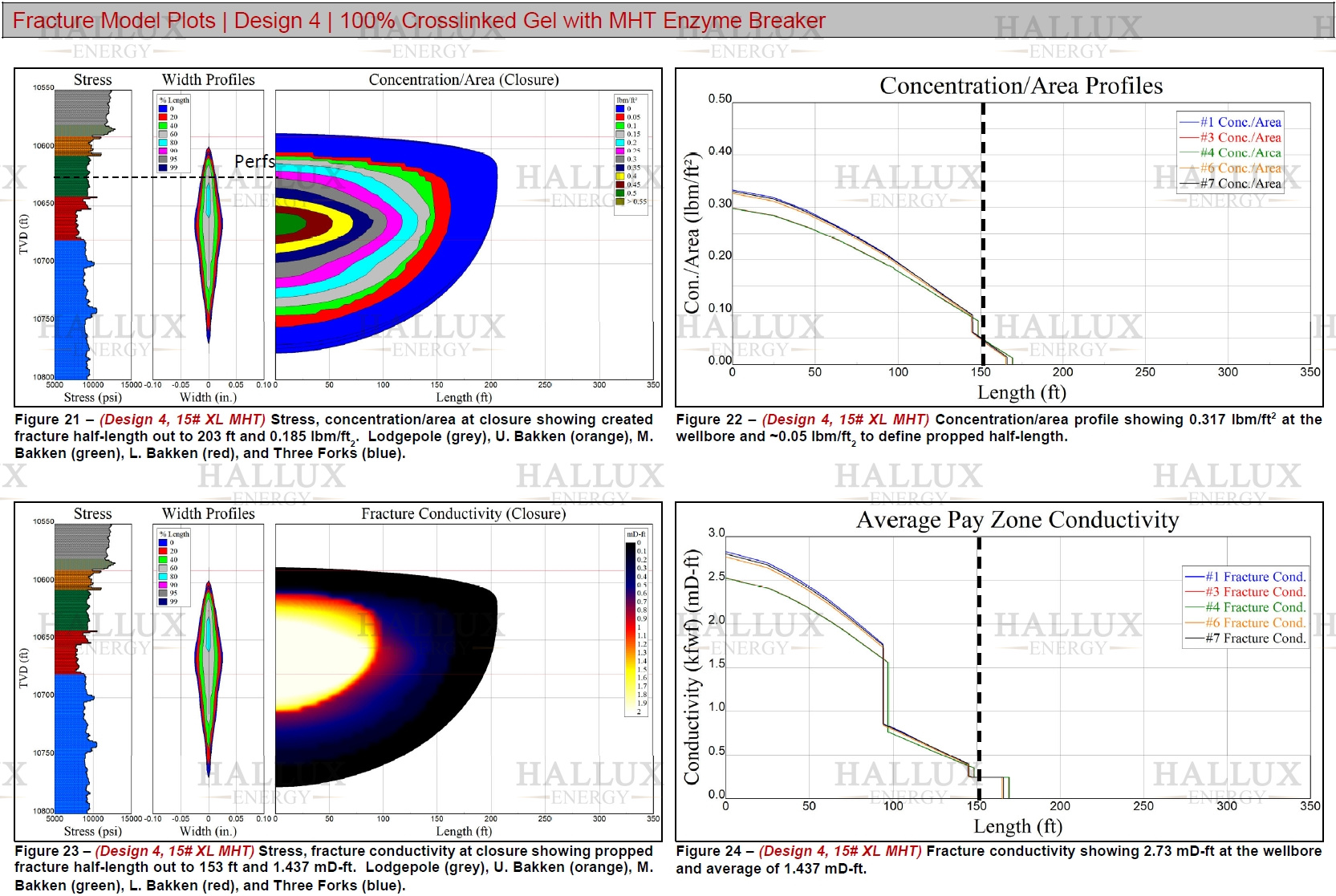
Production forecast shows Design 3 and Design 4 with the best performance using hybrid and full crosslinked gel systems with MHT enzyme breaker. The Mannanase HT designs show a 27–29% increase compared to the baseline, or 58–62 Mbbl at 1 year.
| Model Run | Design 1 | Design 2 | Design 3 | Design 4 | Bakken Analog Well |
|---|---|---|---|---|---|
| Pump Schedule | SW | Hybrid | Hybrid | Full Crosslinked | SW HVFR |
| Fluid 1 | Slickwater | Slickwater | Slickwater | 15# XL+MHT | SW HVFR |
| Fluid 2 | — | 15# LIN+BHL-48 | 15# LIN+MHT | — | — |
| Fluid 3 | — | 15# XL+BHL-48 | 15# XL+MHT | — | — |
| Breaker Type | — | Oxidizer | Hallux Mannanase HT | Hallux Mannanase HT | — |
| Total Fracture Height, ft | 197 | 171 | 166 | 184 | 209 |
| Propped Height, ft | 156 | 128 | 129 | 141 | 157 |
| Created Frac Half-Length, ft | 327 | 235 | 230 | 203 | 320 |
| Propped Frac Half-Length, ft | 212 | 188 | 168 | 153 | 220 |
| Avg Hydraulic Frac Width, ft | 0.063 | 0.145 | 0.119 | 0.141 | 0.064 |
| Base Frac Conductivity, mD-ft | 0.282 | 0.399 | 0.893 | 1.042 | 0.267 |
| Regain Frac Conductivity, mD-ft | 0.533 | 0.568 | 1.232 | 1.437 | 0.468 |
| 3 Month EUR, Mbbl | 99 | 101 | 159 | 158 | 103 |
| 6 Month EUR, Mbbl | 156 | 157 | 219 | 216 | 156 |
| 12 Month EUR, Mbbl | 221 | 223 | 278 | 274 | 216 |
| 1-year Uplift | 2.3% | 3.2% | 28.7% | 26.9% | PM Baseline |
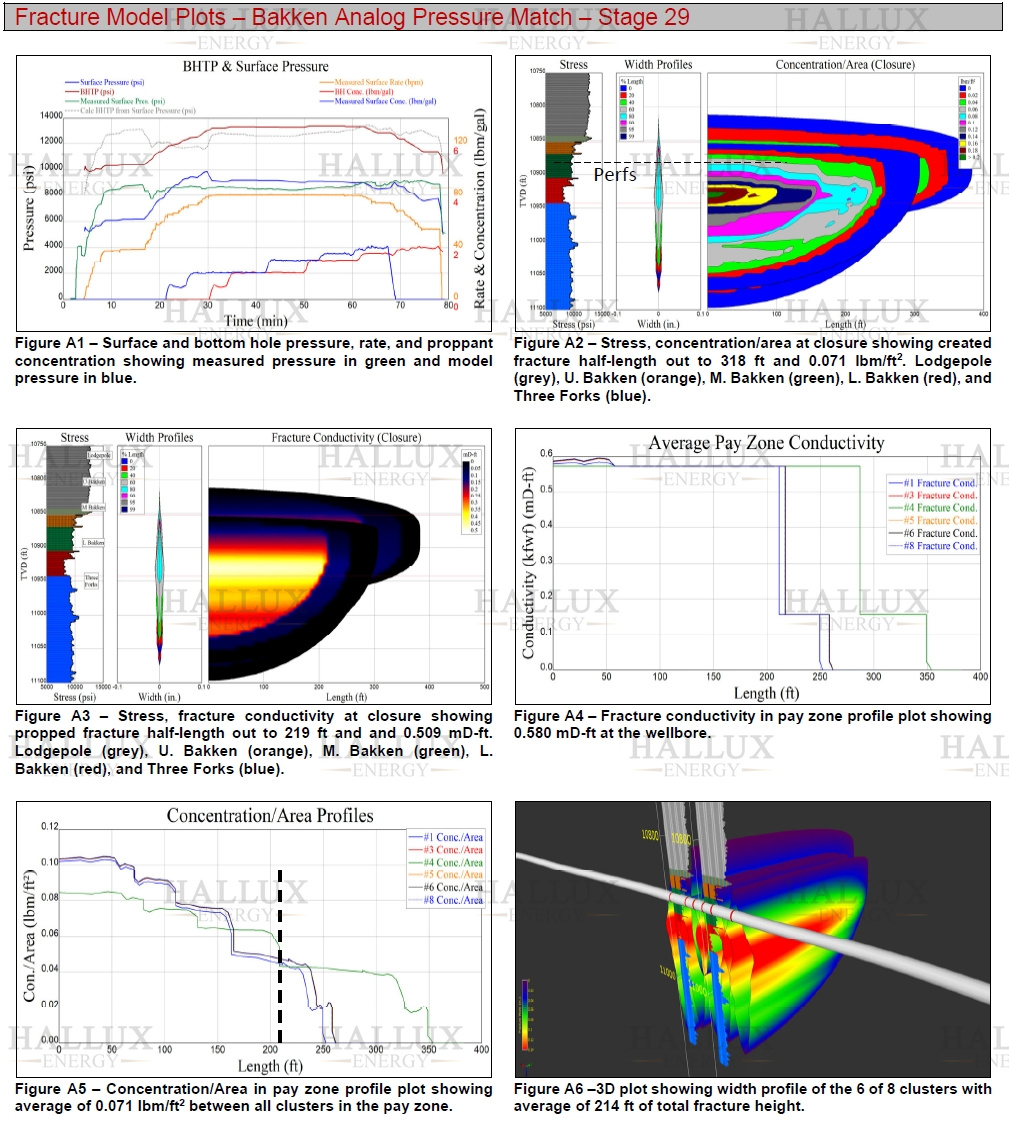
Analog Pressure Match — Baseline analog used for calibration to measured pressure and proppant response. Propped height 151 ft, propped half-length 219 ft, regained conductivity 0.51 mD-ft.
Mannanase HT enzyme designs (D3, D4) show 27–29% production uplift at 1 year versus the baseline. Toggle to Revenue to see the incremental value at current EIA oil prices.