
Enzyme treatment engineered to degrade and remove polymeric damage from drill-in fluids — including xanthan, starch, and cellulose. Independent laboratory testing shows regained permeabilities in excess of 90%, with field case histories demonstrating production increases up to 240% over acid-treated offset wells.
Conventional drilling muds use polymers — xanthan, starch, and cellulose — to carry cuttings, suspend solids, and prevent fluid loss. These polymers form a tenacious filter cake and "skin" on the formation near the wellbore, severely reducing formation permeability and limiting production.
This damage is magnified in horizontal, multilateral, and open-hole completions where the exposed formation area is greatest. Even "drill-in" fluids, while cleaner than traditional muds, still require polymers that leave residual damage.
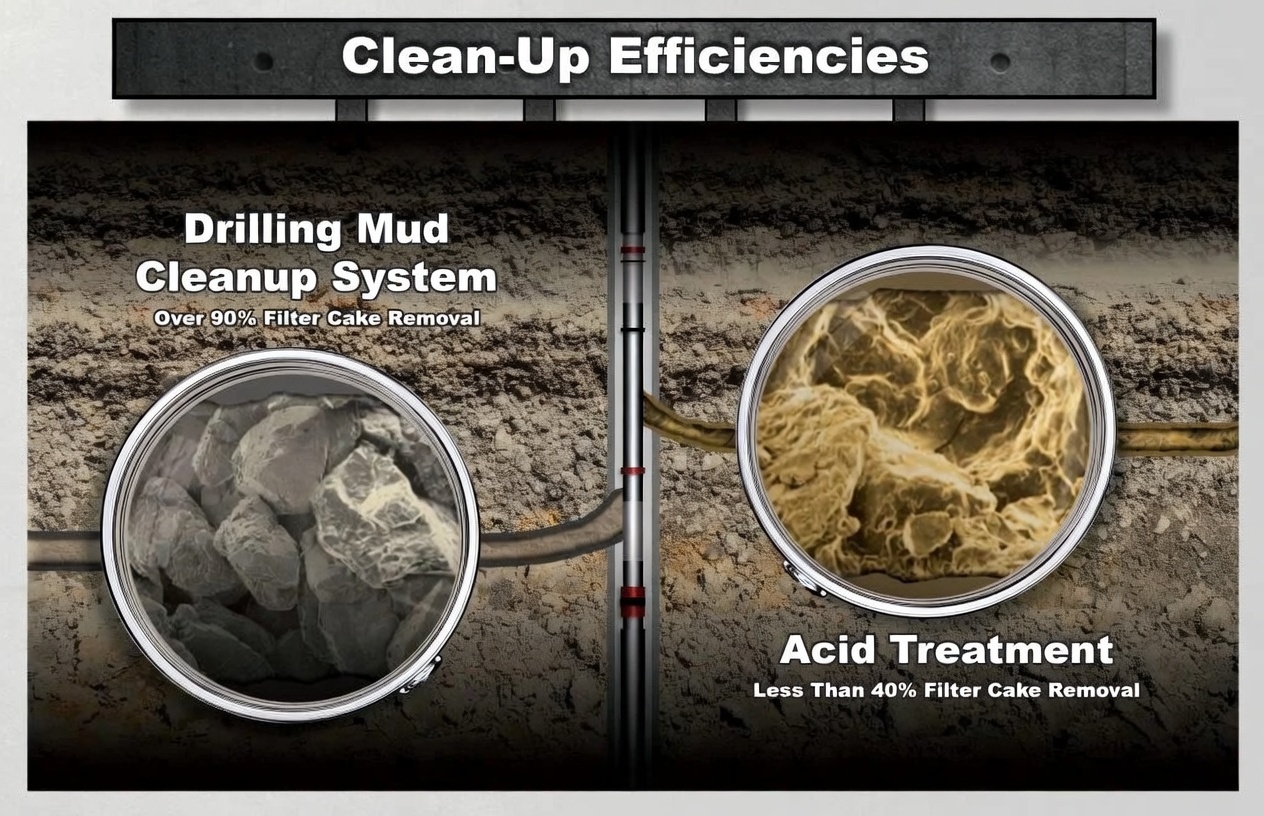
Typical acid treatments react in a stoichiometric ratio — once the acid is spent, there are no further chemical reactions. Independent laboratory testing has consistently shown regained permeability results of less than 40% for clean-ups using acids or oxidizers. They also react indiscriminately with the formation, tubulars, and non-targeted components — causing corrosion and negative side reactions.
Hallux enzymes are catalysts — they are not consumed in the reaction like acids and oxidizers. They continue to degrade each type of polymer they are specifically designed for until the polymeric residue is virtually eliminated. MuddAse enzymes will not oxidize or react with other additives in the fluid system, formation, or tubulars.
Customizable per well. Hallux considers the type of polymers being utilized, polymer ratios, temperature, pH, treatment time, and formation sensitivity to determine the proper enzyme solution. By combining enzymes that remain functional in the presence of other types of enzymes, Hallux can degrade a variety of different polymers with one treatment.
Option 1 — Cement Pumps
Pump MuddAse at 3–4 bbl/min using cement pumps. Treatment volume is 2× the open-hole volume. Allow a soak time of 6–10 hours to overnight before flowback. Minimal equipment required — quickly applied in the field.
Standard application for most horizontal and open-hole completions.
Option 2 — Coiled Tubing
Run coiled tubing to the toe and pull out while displacing MuddAse. Treatment volume is 2× the open-hole volume. Allow a soak time of 6–10 hours to overnight. This method ensures uniform coverage of the entire lateral section.
For wells requiring precise placement across the lateral.
Over 90% Regained Permeability
Independent laboratory testing has consistently shown regained permeabilities in excess of 90% when using MuddAse enzyme treatments — compared to less than 40% for conventional acid or oxidizer cleanups.
Over 90% Filter Cake Removal
Hallux enzyme treatment consistently achieves over 90% filter cake removal, compared to less than 40% for conventional acid treatments. The enzyme targets specific polymer linkages without damaging the formation.
240% Production Increase
Field case histories show enzyme-treated wells produced an average of 5,591 bbl/day — 2.4× the expected production of 2,300 bbl/day. Acid-treated offset wells averaged only 1,986 bbl/day against a 2,500 bbl/day expectation.
55% Less Shut-In Time
Enzyme-treated wells averaged 13.1 hours shut-in time, compared to 29 hours for acid-treated offset wells. The reduced shut-in time alone represents an additional $152,587 in revenue savings.
| # of Wells | Avg Lateral Footage | Expected Avg Production (bbl/day) | Actual Avg Production (bbl/day) | Avg Shut-In Time (hrs) | Avg Increased Gross Profit/Day Oil @ $70/bbl |
|
|---|---|---|---|---|---|---|
| Drilling Mud Cleanup System | 4 | 2,870 | 2,300 | 5,591 | 13.1 | $230,370 |
| Acid Treatment — Offset Wells | 7 | 3,305 | 2,500 | 1,986 | 29.0 | ($35,980) |
*Does not include the additional revenue from the reduced shut-in time compared to conventional acid treatments.
The Hallux line of enzymes is the result of over 20 years of research and development. Hallux Energy uses genetically modified organisms to produce enzymes engineered for the specific polymers used in drilling operations, as well as specific bottom-hole conditions — resulting in unsurpassed regained permeabilities.
Unlike acids and oxidizers that react indiscriminately, Hallux enzymes break only very specific linkages in the target polymer. They are biological catalysts that continue working until the polymer is fully degraded — they are not consumed in the reaction.
Key advantage: Reduced viscosity does not necessarily mean a fluid is "truly broken." Polymeric intermolecular interactions and shear thinning effects can give the appearance of a broken fluid while significant damage remains. Hallux enzymes degrade polymers to very low molecular weight fragments — ensuring actual cleanup, not just reduced viscosity.
All Hallux enzymes are manufactured in the USA, environmentally friendly, 100% biodegradable, and not DOT, IATA, or UN regulated. No negative side reactions. Minimal equipment required for application — quickly deployed in the field using cement pumps or coiled tubing.
Hallux drilling enzymes are specifically engineered to degrade the polymers found in drill-in and drilling fluids. Each treatment is customized based on the specific polymer types, ratios, and downhole conditions of the target well. Not all enzymes are created equally.