
Drill-Out Cleanup
The Challenge
Xanthan-based drill-out and aphron fluids are widely used to drill out composite plugs in horizontal completions. While effective during the operation, these fluids leave behind xanthan polymer residue that invades the formation and proppant pack — reducing permeability, restricting conductivity, and limiting flowback.
Traditional oxidizer breakers such as ammonium persulfate often fail to fully clean up this damage. Independent laboratory testing has shown that oxidizer breakers can actually reduce regain permeability compared to untreated wells — leaving operators with underperforming completions and lost production.
Hallux Xanthanase HT 20K is specifically engineered to fully degrade xanthan polymers under downhole conditions, restoring formation permeability and proppant pack conductivity to near-original levels. It is the only enzyme breaker purpose-built for xanthan gum — and it has no competitive equivalent on the market.
How to Apply
Option 1 — Blend Into Drill-Out Fluid (Recommended)
Add Xanthanase HT 20K concentrate directly into the drill-out fluid before pumping. The enzyme is fully compatible with xanthan-based aphron systems and begins degrading the polymer immediately. Because it travels with the fluid, it remains effective even when drill-out fluid is lost into the formation — providing the most complete cleanup possible with the simplest execution.
This is the most effective and cost-effective application method.
Option 2 — Remedial Coiled Tubing Treatment
For wells that have already been drilled out without enzyme treatment, Xanthanase HT 20K can be applied as a remedial cleanup. Using coiled tubing, pump the treatment to the toe and pull out while displacing. Load into a clean carrier fluid, with a treatment volume of 1.5–2x the open-hole volume. Allow a minimum soak time of 16–24 hours before flowback.
This method is effective but less likely to contact all fluid lost into the formation during the original drill-out.
Proven Results
Independent laboratory testing at Stim Lab and PropTester has validated the performance of Xanthanase HT 20K across multiple downhole-simulated conditions:
100% Regain Permeability — Stim Lab testing on Bandera sandstone cores at 160°F showed complete permeability restoration when Xanthanase HT was blended into the aphron fluid. By comparison, ammonium persulfate achieved only 65% regain.
Up to 99.4% Conductivity Regain — PropTester evaluations using 40/70 Northern White sand demonstrated near-full conductivity recovery in proppant packs treated with Xanthanase HT — whether blended into the fluid or applied as a preflush.
Lowest Filtercake Lift-Off Pressure — Enzyme-treated cores required only 132 psi to lift the filtercake, compared to 168 psi with no breaker and 249 psi with ammonium persulfate. Lower lift-off pressure reduces stuck pipe risk and supports flowback in low-pressure wells.
Works at Both Proppant Concentrations — Tested and proven at both 1.0 and 2.0 lb/ft² proppant loading with consistent results.
Operational Details
Xanthanase HT 20K is non-hazardous, not DOT regulated, and environmentally friendly — requiring no special handling, storage, or disposal. It is non-corrosive to metals and compatible with all formation types, base waters, tubular goods, and proppants. Effective across a temperature range of 100°F–275°F and pH range of 3–11.
Competitive Products
There is no equivalent xanthan-specific enzyme breaker on the market. Xanthanase HT 20K is the only purpose-engineered enzyme for degrading xanthan gum under downhole conditions.
Stop leaving production on the table. Contact us to learn how Xanthanase HT 20K can improve your drill-out cleanup and maximize well productivity.
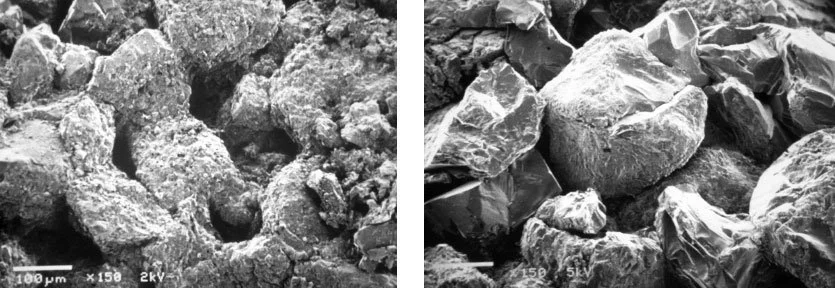
Sandstone Core Before & After Xanthan Removal